
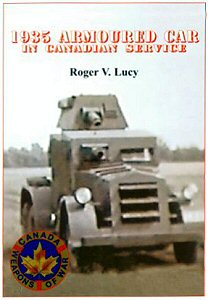
 1935
Armoured Car
in Canadian Service
1935
Armoured Car
in Canadian Serviceby Roger V Lucy.
Canada's Weapons of War Series, WOW011
A5 size softback, 24 pages
ISBN: 1-894581-28-8
Service Publications,
Canada
www.servicepub.com
Review by Peter Brown
Canada in the 1920s and 1930s only had small armed forces, a limited defence budget and equally limited armament production facilities. Despite that attempts were made to adopt new ideas which included mechanisation of infantry and artillery units though the cavalry still retained horses. Plans to buy armoured cars came and went, but in 1932 firm decisions were made and two armoured cars were ordered.
One each were to be built by Ford and Chevrolet using parts available from current production trucks. Patterned on an existing British Crossley design and produced in mild steel not armour plate, they were intended to train units and also to find any problems in manufacturing such vehicles if needed. The first stumbling block was to obtain suitable rear axles as a 6x4 layout was called for and such vehicles were not produced in Canada. The Chevrolet vehicle used a British Leyland unit while the Ford one used a suitable design from its American parent company.
Although very similar in appearance, there were some differences. The Ford car used twin rear wheels while the Chevrolet one used single wheels. Body panels were welded together though it was expected than any production cars would be riveted. Delays in obtaining suitable AFV-pattern Vickers machine guns meant that they were initially used without any armament. Trials showed good and bad points from different mobility in sand and muddy conditions as well as a lack of rain proofing.
By the time trials were completed ideas on armoured car design had moved away from boxy 6x4 designs. Only the two pilot vehicles were built, they served until around mid-1941 when they were superseded and generally disappeared from the records, presumed scrapped.
Although they did not make a big impact on armoured vehicle development - Canadian wheeled AFVs built in WW2 owed little or nothing to them - they are nevertheless interesting vehicles to study in their own right. The author has put together their story from available sources and his account is backed up by period photos, data tables, a breakdown of markings which changed several times in their relatively short lives and a set of 1/35 scale plans which cover the similarities and differences of the two cars.
An unusual subject which not many people will know about, though specialist this is a good account and ideal for someone wanting something out of the ordinary.
Thanks to Clive Law at Service Publications for the review book.